
📝 [Common Section] From “Listening to Music” to an Experience That Inspires Creativity
The influence of classical music is immeasurable.
One of the things I value most in game development is carefully selecting the BGM that best fits each scene.
When choosing music, I believe it is extremely important to be familiar with classical masterpieces, as well as modern music that incorporates elements of classical music.
Through this series, I would like to share the perspective I use when selecting the right music.
The music featured in this series, including classical pieces, has been carefully selected from the music I have listened to extensively for more than seven years.
Each piece combines accessibility with the ability to inspire creativity.
I hope this series can serve as a shortcut—or perhaps the shortest route—to helping you discover music that can inspire your own creative work.

Among modern composers, one person I particularly respect is Koichi Sugiyama, who composed the music for the Dragon Quest series.

Let me share one of his quotes that has stayed with us.
“The reason Mozart’s and Beethoven’s music has continued to be loved for hundreds of years is that it contains the essence of music that never grows old.”
— Koichi Sugiyama(Dragon Quest)
In fact, classical music is even used in the aging of wood.
One method, known as “acoustic aging,” involves allowing wood to mature and dry naturally at room temperature while exposing it to classical music.
The idea is to let the wood mature gradually without placing unnecessary stress on it.
This unusual application of music is used by some manufacturers and building-material companies that work with natural materials.
It is said that allowing wood to mature without stress helps bring out the natural qualities of the material.
🎼 A Composer Who Used Colorful Orchestration to Bring Russian Folklore and History to Life
It has been quite a while since I last wrote one of these classical music articles.
By the way, the display I sent out for repair has finally returned!
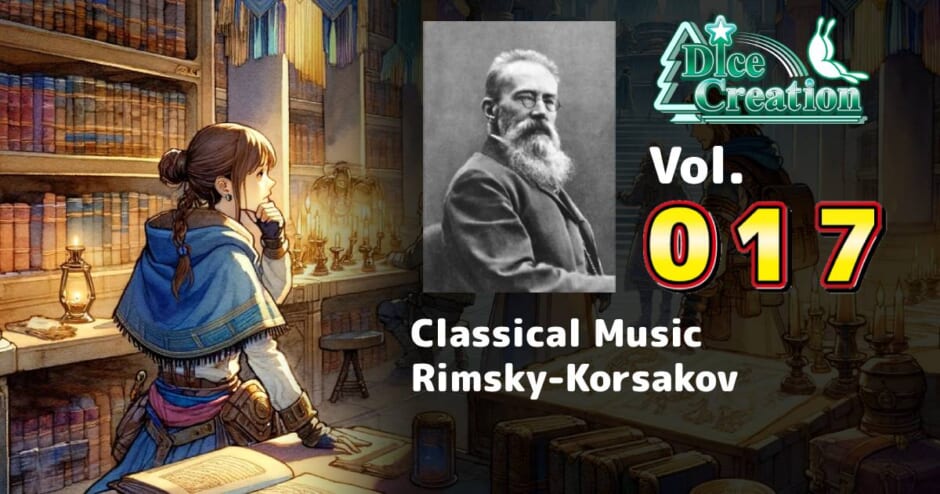
So, as promised, this time I’d like to introduce Rimsky-Korsakov, one of the members of the “Mighty Five.”

That’s the group that also included Mussorgsky and Borodin, right?
That’s right. He was known as a “master of orchestration” and had a deep understanding of the unique characteristics of each instrument’s tone.
Today’s piece takes place at a banquet, but beneath its surface-level splendor, there is also an unsettling atmosphere.

And the arrangement makes use of the unique tonal characteristics of each instrument.
His distinctive musical style comes from combining Russian folk elements with colorful orchestration.
Rimsky-Korsakov was a composer who carefully studied the different qualities of each instrument and used them in different ways throughout his works.
He also worked on preparing Mussorgsky’s Night on Bald Mountain and Borodin’s opera Prince Igor for orchestral performance, as well as helping to complete works by his fellow members of the Mighty Five.
His deep knowledge of orchestration was undoubtedly an important part of this work.
Knowledge is a lifelong asset. However, I believe that individuality can emerge from how we choose to use that knowledge.
Rather than simply accumulating knowledge, we can turn it into something meaningful by sharing it with others or applying it when creating something ourselves.
Rimsky-Korsakov’s use of different instrumental colors is one example of how knowledge can be transformed into creative expression.
When I was developing my first RPG, I added a small twist to one of the enemies.
It was an enemy inspired by the well-known Japanese urban legend Kuchisake-Onna.
I kept the same name, but reimagined the creature around the idea of rotten alcohol. Its attacks scatter rotten alcohol around the battlefield, reducing the player’s HP.
It is quite a troublesome enemy, but I thought the idea was amusing enough to actually implement it.
Whether or not you would call it a “creative technique,” I believe these kinds of small playful touches can also become part of a creator’s individuality.
🎻 About Rimsky-Korsakov & the Featured Music
He was known as a master of orchestration and was one of the leading members of the Mighty Five.
Rimsky-Korsakov was born in 1844 in Tikhvin, in northwestern Russia, and was one of the leading members of the “Mighty Five.”
He became familiar with the piano at an early age, but because his family had strong ties to the navy, he entered the Naval Academy in Saint Petersburg at the age of twelve.
It was there that he later met Mily Balakirev, one of the central figures of the Mighty Five, and began studying composition seriously.
As a naval officer, he spent approximately two and a half years traveling aboard a warship.
He continued composing during his voyages, and his Symphony No. 1 was premiered in 1865.
In 1871, at the age of 27, he became a professor at the Saint Petersburg Conservatory. While teaching, he also studied counterpoint and orchestration more systematically, further developing his skills as a composer.
In 1872, he married pianist Nadezhda Purgold and continued to work actively as both a composer and educator.
Among his students were later-generation composers such as Igor Stravinsky, Alexander Glazunov, and Ottorino Respighi.
His textbook Principles of Orchestration, based on his own experience, is still read by people studying composition and orchestration today.
He left behind a wide range of works, from orchestral music to opera. His colorful sound, created through his skillful use of different instrumental timbres, as well as his storytelling inspired by Russian folklore, folk songs, and history, are among the defining characteristics of his music.
His best-known works include the orchestral pieces Scheherazade, Capriccio Espagnol, and Russian Easter Festival Overture, as well as the operas The Snow Maiden, Sadko, and The Golden Cockerel.
The piece featured this time comes from the opera The Tsar’s Bride, which is set during the era of Ivan the Terrible. It is performed during a banquet scene.
Today’s piece takes place during a lavish banquet, but beneath the cheerful atmosphere, there is a sense that something is being plotted.
It is an opera based on The Tsar’s Bride, a play by Russian dramatist Lev Mey.
So the characters and scenes are also expressed through the different tones and colors of the instruments!
Let’s imagine what kinds of scenes and images come to mind as the music unfolds!
- A Lavish Banquet: A lively banquet where a large crowd gathers, enjoying food and drink together.
- Behind the Banquet: While a lavish banquet is taking place, someone in charge is secretly carrying out a plan that no one else knows about.
- A Secret Plot Unfolding: A plan quietly moves forward in the middle of a crowded gathering, without anyone noticing.
- The Moment Fate Begins to Move: Someone witnesses a mysterious phenomenon in the distance and places their hope in an unknown figure, thinking, “This person could change the world.”
The songs will play continuously. Please be aware of this.
🔜 Next Time & Final Thoughts
What did you think of Rimsky-Korsakov’s life and music?
I was impressed by how he skillfully combined the tones of different instruments to portray not only the splendor of the scene, but also the unsettling presence hidden beneath it.
Especially toward the end, the low and powerful singing creates a strong sense of hostility—as if someone is determined to crush their opponent or get in their way.
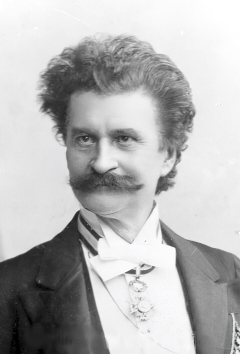
And next time, since we’ve covered opera for a while, we’ll change things up and return to two pieces by Johann Strauss II!
Stay tuned.
📢 Follow and Support
If you’d like to support what DiceCreation does going forward, following us on social media means a lot and keeps us motivated to post!
I’d be so happy if you followed us. We’ll keep the updates coming quickly, so please do~!
The latest news from DiceCreation is published on our official site.
Site updates and announcements are also posted on the official social accounts below.
X is right here!

And Bluesky is over here.